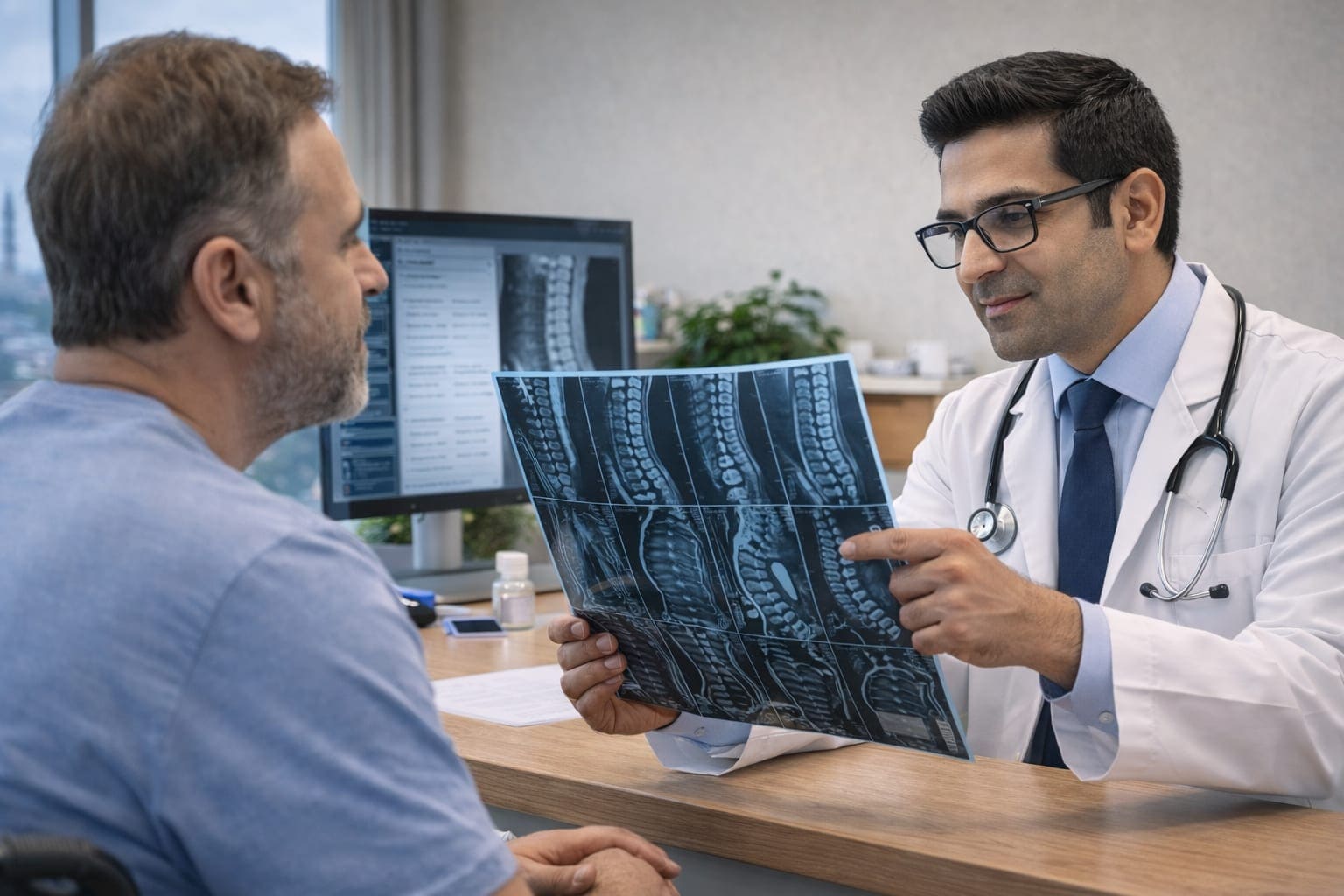
Understanding Spinal Cord Injury
Spinal cord injury (SCI) results from traumatic or non-traumatic damage to the spinal cord and can lead to partial or complete loss of motor function, sensation, and autonomic control below the level of injury. It may affect walking, hand use, bladder function, bowel control, pain, blood pressure regulation, and overall independence.
One of the most important things to understand about SCI is that the initial trauma is only part of the problem. After the primary injury, a secondary injury cascade may continue to damage tissue through neuroinflammation, oxidative stress, excitotoxicity, edema, microglial activation, and glial scar formation.
Conventional care typically focuses on surgical stabilization, acute medical management, and long-term rehabilitation. Many patients explore mesenchymal stem cell therapy and exosome therapy because they want to know whether the post-injury neurological environment can be supported more aggressively.
Why SCI Recovery Is So Difficult
The spinal cord has limited natural regenerative capacity. Even when acute survival is achieved, long-term recovery is constrained by several biological barriers:
Primary Trauma Plus Secondary Injury
SCI is not limited to the original mechanical damage. A secondary cascade of inflammation, edema, oxidative stress, and excitotoxicity may continue to extend injury afterward.
Complete vs Incomplete Injury
Incomplete SCI preserves some pathways below the injury level and may offer more room for functional improvement than complete injury, though both are reviewed individually.
Glial Scar and Inhibitory Environment
After SCI, scar-like tissue and inhibitory molecular signals can reduce the spinal cord's natural ability to repair or reorganize itself.
Chronic Neurological and Rehabilitation Challenges
Even after acute stabilization, many patients continue to live with chronic neurological deficits that require long-term rehabilitation and adaptive strategies.
Common Symptoms and Daily Burden
Patients seeking spinal cord injury stem cell therapy in Turkey often present with a complex mix of neurological and functional problems:
Motor Loss and Weakness
SCI may cause partial or complete loss of motor control below the injury level, affecting walking, trunk control, transfers, and hand function depending on level and severity.
Sensory Changes and Neuropathic Pain
Patients often experience numbness, altered sensation, burning pain, electrical sensations, or uncomfortable hypersensitivity below the injury level.
Bladder, Bowel, and Autonomic Issues
SCI can affect bladder awareness, bowel control, blood pressure regulation, sexual function, and autonomic stability, all of which strongly affect daily life.
Spasticity and Functional Burden
Spasticity, stiffness, poor trunk stability, transfer difficulty, pressure management, and fatigue often become major barriers to independence.
How Stem Cells May Support SCI Recovery
Wharton's Jelly mesenchymal stem cells (WJ-MSCs) are studied for SCI because they may affect several injury-related pathways at once. The aim is not to promise full reversal, but to explore whether the spinal cord environment can become more supportive of recovery, function, and rehabilitation responsiveness.
- Anti-inflammatory modulation aimed at reducing the secondary injury cascade after spinal trauma
- Neurotrophic factor secretion such as BDNF, NGF, GDNF, and NT-3 that may support neuronal survival
- Microglial polarization away from more destructive inflammatory patterns
- Possible reduction of glial scar density and inhibitory post-injury signaling
- Support for oligodendrocyte-related pathways and remyelination of surviving axons
- Angiogenic signaling that may support microvascular recovery around the injury site
- Antioxidant and tissue-supportive signaling relevant to oxidative neuronal stress
- Potential support for a more permissive environment for rehabilitation-driven neural plasticity
Neuroinflammation Reduction
One of the biggest reasons patients explore stem cell therapy for spinal cord injury is the possibility of reducing the secondary inflammatory damage that continues after the initial trauma.
Neurotrophic and Tissue-Supportive Signaling
MSCs are studied because they may release signaling molecules relevant to neuronal survival, tissue support, remyelination-related pathways, and a more favorable post-injury microenvironment.
Rehabilitation Synergy
Many patients are not looking to replace physiotherapy or rehabilitation. They are looking for a biological strategy that may help the nervous system respond better to the rehabilitation work they are already doing.
Exosome Therapy for Spinal Cord Injury
Exosome therapy is sometimes discussed as an adjunctive neuroregenerative strategy because exosomes may carry anti-inflammatory microRNAs, neurotrophic factors, and anti-apoptotic proteins relevant to the injured spinal cord environment.
In SCI, exosomes are of interest because they may help support signaling related to inflammation reduction, glial scar modulation, neuronal survival, and axonal guidance. They are typically considered part of a broader protocol rather than a stand-alone cure.
Living with a Spinal Cord Injury?
Submit your ASIA assessment, spinal MRI, surgery reports, rehabilitation summary, and current functional status for a free evaluation.
Why Patients Explore Regenerative SCI Therapy
Patients usually inquire because they are seeking more than one outcome at the same time: neurological support, pain reduction, better tone management, more function, and a more recovery-friendly environment for rehabilitation.
Neuroinflammation Reduction Goals
Patients often explore regenerative therapy because the secondary inflammatory cascade is a major driver of extended damage after SCI.
Neural Plasticity Support
A major motivation is the hope of improving the neurological environment in which rehabilitation and functional retraining take place.
Pain, Tone, and Autonomic Function
Many patients are not only looking for motor change, but also for better sensation, less neuropathic pain, improved spasticity, and better autonomic awareness.
Rehabilitation Synergy
Patients often explore treatment in hopes that the spinal cord environment becomes more responsive to long-term rehab work.
Who May Be Eligible for Spinal Cord Injury Stem Cell Therapy in Turkey
Eligibility depends on injury level, completeness, time since injury, medical stability, and rehabilitation context:
- Patients with complete or incomplete spinal cord injury seeking investigational neuroregenerative support
- Patients with paraplegia, tetraplegia, sensory deficits, neuropathic pain, spasticity, or autonomic dysfunction
- Patients able to provide ASIA assessment, MRI imaging, surgery reports, and a clear functional summary
- Patients whose bladder management, pressure sore status, infection risk, and overall medical condition are stable enough for treatment planning
- Patients who understand that treatment is investigational and should complement rehabilitation rather than replace it
Your SCI Treatment Journey in Istanbul
- 1
Neurological Record Review
Submit ASIA assessment, spinal MRI, operative reports, rehabilitation notes, and functional status for candidacy evaluation.
- 2
Personalized SCI Protocol
If appropriate, a treatment plan is prepared based on injury level, severity, route selection, rehabilitation goals, and realistic expectations.
- 3
Treatment in Istanbul
Protocols may include intrathecal MSC therapy, IV infusion, and selected exosome support depending on the case.
- 4
Rehabilitation and Follow-Up
Patients continue structured rehab with follow-up that may track ASIA changes, functional milestones, pain, tone, bladder awareness, and overall quality of life.
Why International Patients Choose Istanbul
Patients looking for spinal cord injury treatment in Turkey often want neurological review, regenerative medicine access, caregiver-aware travel support, and a more favorable private-treatment cost structure.
Neurology and Rehab-Oriented Review
SCI cases require review of ASIA grade, injury level, MRI findings, surgery history, caregiver needs, bladder status, and travel logistics.
Advanced Regenerative Focus
Our protocols are designed for patients seeking intrathecal, IV, and exosome-based neuroregenerative support for spinal cord injury.
International Patient Access
Istanbul offers strong private medical infrastructure and practical international travel access for patients and caregivers coming from abroad.
Cost Advantage
Turkey often offers a substantial cost advantage compared with many private regenerative medicine programs in the US and UK.
Frequently Asked Questions About SCI Stem Cell Therapy
Medical Disclaimer
Stem cell therapy for spinal cord injury is investigational. Complete motor recovery from complete SCI remains uncommon. Results vary significantly. Treatment should be pursued under medical supervision with realistic expectations and in combination with appropriate rehabilitation.